Startup Founders: When Your Investor Demo Is Not an MVP
Why traction stalls when the product breaks under real signups—and how to scope a market-ready MVP in weeks, not quarters.
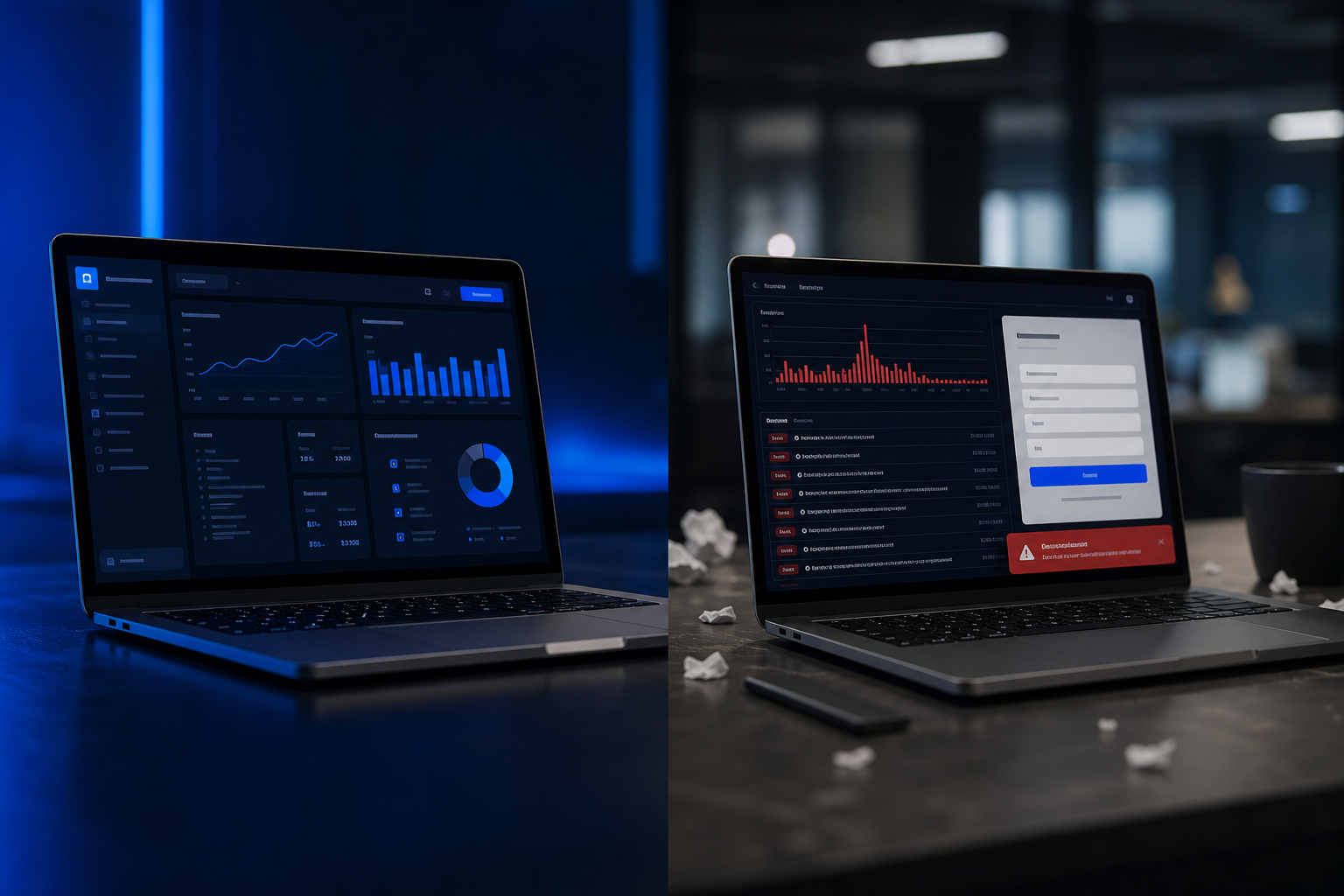
According to CB Insights, roughly 35% of startup failures tie to no market need—often because the product never survived real users. Founders feel that gap when the investor demo works and the first hundred signups do not. This guide explains the difference, how to scope a market-ready minimum viable product, and how to keep runway honest while you learn.
Key Takeaways
- Demos optimize for meetings; MVPs optimize for signup, payment, and support load.
- Scope auth, core flows, deploy, and observability—not every roadmap item.
- Stack choices should help your first engineering hire extend the codebase, not replace it.
- Weekly working demos beat slide updates for investor and customer trust.
Why do demos break under real users?
The short answer: demos skip failure modes. Real users hit slow pages, edge-case validation, password resets, abandoned carts, and mobile layouts you never tested. A clickable prototype in Figma is not an MVP; neither is a localhost build with seed data or a staging environment only your team can access.
Demos are optimized for a controlled narrative: happy-path clicks, prefilled data, and a presenter who knows which button to avoid. Production is optimized for none of that. The National Venture Capital Association ecosystem publishes frequent reminders that investor interest follows traction metrics—active users, retention, revenue—not demo polish alone. When signups spike after a fundraise or press hit, the cracks show in support tickets, churn, and embarrassed founder posts—not in the board deck.
Market-ready means someone can create an account without your help, complete the core job-to-be-done, pay if payment is part of the hypothesis, and you can see every step in production logs and analytics. It does not mean every integration, admin screen, or edge market is finished.
The demoware checklist (honest self-audit)
Ask your team yes or no:
- Can a stranger sign up without a magic link you email manually?
- Does password reset work on mobile Safari and Chrome?
- Are errors logged somewhere you check daily?
- Is there a billing or commitment step if your pitch assumes revenue?
- Can you deploy a fix in under an hour without heroics?
Any “no” is not a moral failure—it is scope you have not funded yet. Name it before investors or design partners do.
What breaks first under load
In our delivery work, the first failures are predictable: email deliverability, rate limits on third-party APIs, missing database indexes on the one list view everyone uses, and session handling across subdomains. Demos rarely exercise any of these. Planning for them in MVP scope is cheaper than emergency firefighting during a launch week.
Citation capsule: Demos skip failure modes; MVPs must survive self-serve signup, mobile browsers, and production logging—otherwise the CB Insights “no market need” bucket often means “no usable product,” not “no idea.”
What belongs in a founder MVP?
Cut scope to what tests your hypothesis—the smallest release that proves or disproves who it is for, what they do, and how you will know it worked. Everything else is a distraction funded by runway you may not have.
Identity and access
Real accounts matter. Shared test logins hide onboarding friction. Plan for:
- Email verification or OAuth your audience already uses
- Password reset and session persistence
- Basic roles if admins and end users share one app
Skip: complex SSO, custom permission matrices, and audit logs unless enterprise buyers are the only path.
One core workflow end to end
Pick the loop that defines value: book, pay, submit, match, publish, monitor. Build it completely:
- Validation and empty states
- Clear errors a user can recover from
- Success state you can measure in analytics
Do not build three half workflows. One finished path teaches more than three demos.
Production deploy and observability
Ship on AWS, Vercel, or equivalent with:
- Error tracking (Sentry or similar) from day one
- Uptime monitoring on the URL you give customers
- Environment separation (staging vs production) even if staging is minimal
Founders who skip this learn about bugs from Twitter before they learn from dashboards.
Analytics on success steps
Define events before launch: signup_completed, core_action_done, payment_succeeded. Tie them to the story you tell investors. Vanity pageviews rarely convince anyone; completion rates do.
Stack: why React and Next.js are a strong default
The Stack Overflow Developer Survey year after year shows JavaScript ecosystems dominating web hiring. React and Next.js give you:
- Server components and server-first data loading for performance without a separate BFF on day one
- A hiring pool your first full-time engineer likely already knows
- A path from MVP to scale without a rewrite when the feature list doubles
Node on the API side keeps language overlap for small teams. See software for startup founders for how phased delivery maps to runway.
What to defer (even if the deck mentions it)
- Full admin suites and internal tooling beyond one ops view
- Native mobile apps (responsive web often suffices until retention proves channel need)
- Multi-region infra (unless compliance demands it)
- AI features that do not change the core loop yet
[PERSONAL EXPERIENCE] Teams we work with often freeze scope after discovery into fixed phases—discovery, build, launch, handoff—so runway math stays honest without hourly surprises.
How do you scope in weeks, not quarters?
Velocity comes from decisions, not heroics. A practical 8–12 week v1 after discovery is achievable when scope is truly minimal and a senior team (or partner) is not learning your domain from zero.
Week 0: discovery that ends in a written scope
One week of structured discovery should produce:
- Hypothesis statement (who, job, success metric)
- In-scope user stories (often 8–15, not 80)
- Explicit out-of-scope list
- Risk register (integrations, compliance, data migration)
If discovery cannot fit one page, the MVP is probably not an MVP.
Weeks 1–8: build and demo weekly
Weekly demos of working software in a shared environment. Each demo answers:
- What did we ship?
- What did we learn from users or proxies?
- What did we cut and why?
Adjust order when customer calls change priorities—but visible tradeoffs, not silent scope creep.
Weeks 9–12: launch and instrument
Harden auth edges, payment flows if any, and support playbooks. Load-test the one page that will spike. Write a one-page runbook: how to deploy, roll back, and who gets paged.
Fixed phases vs open-ended hours
Open-ended agency hours favor endless polish. Fixed phases with defined deliverables favor learning. You can still change scope between phases; you should not discover cost mid-phase without a conversation.
How do you keep investors aligned while scoping small?
Investors care about learning speed and capital efficiency more than feature count in v1. Replace slide-only updates with:
- Metrics: activation, retention cohort, revenue if live
- Demos: real URLs, real accounts (theirs if they want)
- Decisions: what you stopped building and why
When you cut scope, explain the hypothesis link: “We removed X because it does not test whether users will pay for Y.”
Narrative traps to avoid
- Claiming “AI-first” when the product is rules plus an API call
- Showing design comps as shipped product
- Burying known bugs as “known issues we will fix later” without dates
Transparency builds follow-on meetings; surprises kill them.
When should you add AI?
After the core loop works. LLM features belong where they change user behavior or unit economics—not where they only change the pitch deck.
If the story is AI-first, ship a thin vertical slice:
- Clear input and output contract
- Graceful degradation when the API is down or slow
- Human review path for high-stakes outputs
- Cost per request visible to you daily
LangChain, Streamlit, or a simple API route behind Next.js can prove value in two weeks inside a larger MVP plan—but not as a substitute for auth, billing, and core workflow.
Link: Applied AI services when you are ready to graduate PoCs.
How do you set up your first engineering hire?
The MVP is also an audition tape for future employees. They will read the repo. Optimize for:
- README with local setup in under 30 minutes
- Consistent folder structure and lint rules
- Typed API boundaries (TypeScript + Zod or similar)
- CI that runs tests on every PR
Pair for a week at handoff if you used an external team. Docs beat heroic knowledge transfer.
Documentation minimum
- Architecture diagram (one page)
- Environment variables list (no secrets in git)
- “How we deploy” and “how we roll back”
- Open questions and known debt labeled honestly
How do cloud and DevOps fit a founder MVP?
You do not need Kubernetes on day one. You do need:
- Automated deploy from main branch
- Secrets not in the repository
- Backups if you store user-generated content
Cloud architecture for startups usually means lean serverless or managed platforms until traffic proves otherwise. Spend engineering time on product learning, not cluster tuning.
Common founder mistakes (and fixes)
| Mistake | Fix |
|---|---|
| Building for scale before signal | Load-test one critical path; defer multi-region |
| Hiring cheapest dev without review | Code review and weekly demos still apply |
| Copying competitor feature lists | Re-anchor on your hypothesis metrics |
| Skipping legal/payment compliance | Budget time for Stripe, tax, privacy policy as needed |
| Treating MVP as throwaway | Build modules you can extend; avoid “rewrite at Series A” plans |
FAQ
How long should a first MVP take?
Many teams target 8–12 weeks for a focused v1 after discovery. Compliance, payments, or hardware integrations add time—name them in discovery, not week six.
Can we keep our no-code prototype?
Sometimes for internal ops. Customer-facing paths usually need a real app once payments, permissions, and support load appear.
What stack should we pick?
Prefer mainstream tools your first senior hire knows. Exotic stacks tax hiring more than they help demos.
Should we outsource or hire?
Outsource or partner for speed when you lack senior bench; hire when core IP and daily iteration must be in-house. Hybrid works: partner builds v1, first hire extends.
How much should we budget?
Varies by scope and region. Fixed-phase quotes after discovery beat hourly open tabs. Compare cost to months of runway burned while founders “just finish” the prototype themselves.
What if we already have a broken MVP?
Audit what to keep vs rebuild. Often auth, data model, or deploy pipeline need repair while UI is salvageable. Honest audit saves more than greenfield pride.
How do we know the MVP succeeded?
Predefine success before launch: e.g. “20 weekly actives completing core action” or “three paying design partners.” Hit the number or learn why not—both outcomes justify the spend.
How do design and engineering share a runway?
Founders often have Figma files, Notion specs, or a strong product instinct—but not a full-time designer and engineer yet. The MVP phase still needs a shared language so neither side gold-plates the wrong layer.
Align on jobs, not screens
Write jobs-to-be-done for the primary persona: “When I ___, I need ___ so that ___.” Every screen should map to a job. If a screen does not, it waits for phase two.
Design tokens and primitives early
Even a minimal set of colors, type, spacing, and button components speeds engineering and makes later hires consistent. You are not building a full design system—you are avoiding one-off CSS that becomes debt.
When to involve users before launch
Five to eight interviews or structured tests on a clickable prototype often save weeks of building the wrong workflow. Combine qualitative tests with analytics after launch; before launch, qualitative wins.
Handoff checklist
- Responsive breakpoints defined for the one workflow that matters
- Empty, loading, and error states designed (not “engineering will figure it out”)
- Copy for emails (verify, reset password) written and tested
- Accessibility basics: focus order, labels on forms, contrast on primary actions
What does a discovery workshop actually produce?
A serious discovery week ends in artifacts investors and engineers can both read:
- Hypothesis one-pager — problem, persona, alternative solutions, why now.
- Scope board — must-have / should-have / won’t-have for v1.
- Technical spikes list — unknowns that need a time-boxed prototype (payment edge case, API limit, import format).
- Success metrics — primary (e.g. weekly active completing core action) and guardrails (support tickets per user, error rate).
- Timeline with demo dates — weekly milestones, not a single deadline at the end.
Discovery is not bureaucracy. It is the cheapest place to kill bad ideas.
Security and privacy baselines for early-stage products
You do not need enterprise SOC2 on day one. You do need:
- HTTPS everywhere, HSTS on production
- Secrets in environment variables or a secrets manager, never in git
- Parameterized queries or an ORM that prevents SQL injection by default
- Rate limiting on auth and public APIs
- Privacy policy and terms accurate about what you collect
- Data export/delete path if you store PII (GDPR-minded investors ask)
If you handle payments, use Stripe or similar so card data never touches your servers. If you handle health or financial advice, get legal input early—scope affects timeline.
Post-launch: the first 30 days after MVP
Launch is the start of learning, not the finish line.
Days 1–7: Watch error rates and signup funnel hourly. Fix crashes before cosmetic bugs. Reply to every early user personally if possible.
Days 8–14: First retention cohort. Who came back? Which step did drop-offs abandon? Cut or simplify that step before adding features.
Days 15–30: One iteration cycle on the core loop only. Resist “we also need integrations” until retention justifies it.
Schedule a retro with your build partner or team: what surprised us, what debt is acceptable for 90 days, what must be fixed before hire #1.
Worked patterns by product shape
B2B SaaS
MVP = one team, one workflow, invite colleagues later. Admin billing can wait if a manual invoice works for design partners. Invest in onboarding that explains value in under five minutes.
Marketplace
Supply and demand both need a minimal path—often one side is manual at first (concierge). Fake liquidity kills marketplaces; honest small geography or category wins.
Regulated or fintech
Budget compliance and audit trails in scope from discovery. MVPs are still small, but “move fast break things” is not an option. Partner with counsel; engineering documents controls.
[UNIQUE INSIGHT] The founders who win are not those with the most features in v1—they are those with the clearest metric that moved in the first 30 days after real users arrived.
How does product engineering engagement fit?
Custom product engineering for founders typically sequences: discovery → MVP build → launch support → handoff to your first hire. Cloud and AI are pulled in only when the hypothesis requires them—not as default upsells.
Related reading: modern JavaScript patterns for teams on React, and Python AI/ML in production when your roadmap includes models after the core loop works.
How do integrations fit an MVP without boiling the ocean?
Founders often need one or two external systems: Stripe, HubSpot, a legacy CSV, a partner API. Treat each integration as a mini-project with its own spike.
Integration priority rubric
Score each candidate 1–5 on: revenue impact, user blocking (cannot complete core job without it), implementation risk (documentation quality, sandbox access), and ongoing ops cost (rate limits, support burden). Build the highest total score first; queue the rest explicitly in “phase two.”
Webhooks and idempotency
If partners send webhooks, store raw payloads, process idempotently, and log failures to a dead-letter queue you actually monitor. Demos that “simulate” webhooks with manual buttons hide the hardest bugs.
Manual bridges are valid
Concierge onboarding, weekly CSV imports, or a founder-triggered admin action can buy weeks of learning before full automation. Label them temporary in your scope doc with a trigger to automate (e.g. “>50 customers” or “>10 hours/week ops time”).
What should founders prepare before a build phase?
- Decision maker available for 24–48 hour feedback on scope questions
- Brand assets (logo, basic palette) or acceptance of sensible defaults
- Legal entity and bank account if payments are in scope
- Sample data representative of messy real input, not only clean CSVs
- List of “never show” edge cases (regions, user types) if compliance applies
Prepared founders compress timelines; unprepared founders still ship, but spend meetings on logistics instead of product calls.
Questions to ask any build partner before signing
- Who will be in weekly demos (named seniors, not rotating juniors)?
- What is explicitly out of scope for phase one?
- How do you hand off to our first hire (docs, pairing, repo access)?
- What happens if we need to pause between phases?
- How do you handle IP and code ownership?
Clear answers prevent the “agency disappeared after launch” story that burns runway twice.
Red flags in proposals
Vague timelines (“we’ll move fast”), no named engineers in demos, unwillingness to show production code from past clients (sanitized), or scope that is only a bullet list without out-of-scope. Ask for references you can call. Clarity before signature beats optimism after.
Closing thought
Traction is the metric that matters. Build the smallest product that earns real usage, instrument it, and let the investor demo catch up to what already works in production—not the other way around.
When you are ready to scope a phase with clear milestones, talk to us or read how we work with startup founders.
Building something similar?
Tell us about your stack, timeline, and goals. We reply within one business day.
Let's Discuss Your Vision