Cloud Architecture: Serverless and CI/CD Basics That Survive Growth
Event-driven AWS patterns, pipelines your team owns, and observability that turns outages into fixes—not fire drills.
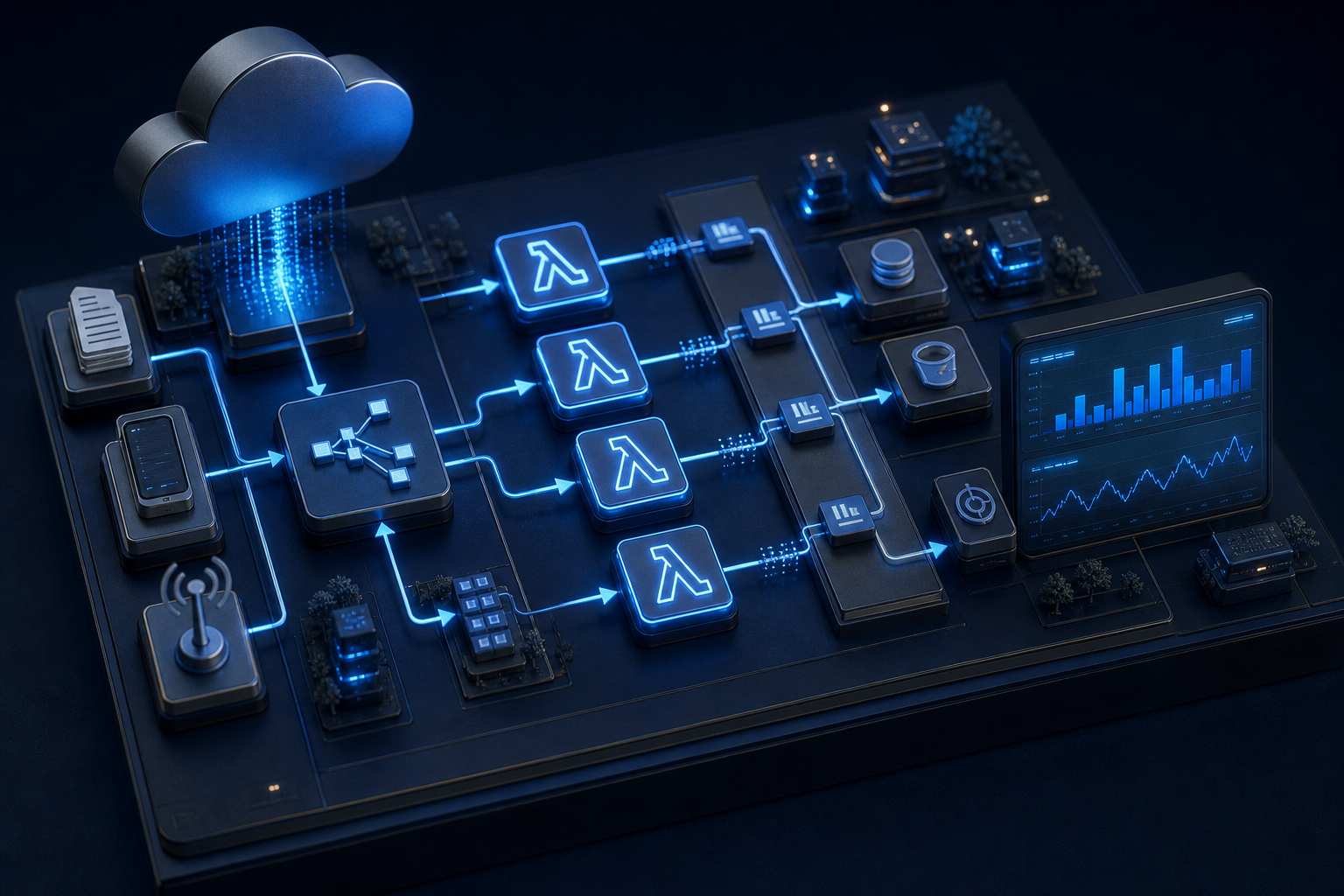
Amazon Web Services reports Lambda processing more than 15 billion function invocations per day. Event-driven compute is no longer experimental. It is the default for new workloads at many startups and enterprises.
The gap for most teams is not whether to use the cloud. It is whether releases feel predictable and incidents feel diagnosable. When deploys are scary and alarms fire on CPU graphs nobody understands, serverless and CI/CD become slide-deck checkboxes instead of operational leverage.
This article covers serverless fit, CI/CD minimums, IAM baselines, and CloudWatch patterns that still work when traffic doubles and the team grows. Whether you are an enterprise engineering leader modernizing legacy integrations or a startup founder shipping an MVP on a tight runway, the same principles apply: own your pipeline, least-privilege access, and measure what users actually feel.
At a Glance
- Lambda, SQS, and EventBridge fit many async workloads; steady high-CPU jobs often belong on containers or instances (AWS Lambda, 2024).
- DORA research links frequent, small deployments to lower change failure rates.
- IAM roles per service, no long-lived keys in repos, secrets in a manager.
- CloudWatch alarms on user-visible symptoms beat dashboards nobody reads during an outage.
When does serverless fit?
Serverless fits workloads with variable or event-driven demand: webhooks, ETL triggers, scheduled jobs, API edges with spiky traffic, and background processing that can tolerate cold starts. Flexera’s 2024 State of the Cloud Report found 89% of organizations use multiple cloud providers, but most still consolidate primary compute on one platform first. On AWS, that usually means Lambda triggered by API Gateway, SQS, EventBridge, or S3 notifications.
Poor fits include steady high CPU with strict sub-100ms latency and no burst pattern, long-running stateful processes, and workloads where per-invocation pricing exceeds reserved capacity at your traffic level. Right-size containers on ECS or Fargate, or use EC2 with autoscaling, when the math favors always-on compute.
What patterns work for event-driven AWS?
Three building blocks cover most greenfield async flows:
| Pattern | Best for | Watch out for |
|---|---|---|
| Lambda + API Gateway | HTTP APIs, webhooks, BFF edges | Payload size limits, timeout caps (15 min max) |
| Lambda + SQS | Decoupled workers, retry with backoff | Poison messages without a DLQ |
| EventBridge + Lambda | Scheduled jobs, cross-service events | Event schema drift without a registry |
Start with one trigger type per function. A Lambda that handles HTTP, SQS, and EventBridge in one handler becomes hard to test, hard to deploy independently, and hard to reason about during incidents.
Cloud architecture & DevOps consulting usually maps event-driven flows first so teams do not lift-and-shift a monolith into fragile Lambda spaghetti. The goal is a diagram where each box has one job, one owner, and one alarm tied to a user-visible symptom.
Citation capsule: AWS Lambda scales automatically with invocation count and charges per request and duration, which makes it cost-effective for spiky or intermittent workloads but expensive for sustained high utilization. Teams should model invocations, memory allocation, and data transfer before labeling a workload “serverless” (AWS Lambda pricing, Amazon Web Services, 2024).
How do you avoid serverless sprawl?
Sprawl happens when every script becomes a Lambda with no shared conventions. Before function count hits double digits, standardize:
- One repo or monorepo module per domain, not one repo per function.
- Shared libraries for logging, error shapes, and IAM role assumptions.
- Infrastructure as code (CDK, Terraform, or SAM) so staging matches production.
- Local testing with sam local or equivalent so developers are not deploying to learn.
[PERSONAL EXPERIENCE] We have seen teams cut incident triage time sharply once they enforce a naming convention: {domain}-{action}-{env}. On-call engineers can grep CloudWatch log groups and IAM role names without opening a wiki page.
[IMAGE: Diagram of event flow from API Gateway through SQS to Lambda workers with DLQ branch - serverless architecture AWS]
What should CI/CD actually do?
CI/CD should make every production change repeatable, reversible, and evidenced. Google’s DORA program found elite performers deploy on demand with a change failure rate under 15%, while low performers deploy monthly or less. The gap is rarely tooling. It is whether the pipeline enforces the same gates for every engineer on every branch.
Minimum bar for enterprise and startup teams alike:
- Run tests and lint on every pull request.
- Build artifacts once, promote through stages (dev, staging, production).
- Support rollback in minutes, not hours.
- Keep staging close to production configuration (same IAM patterns, same env var keys, scaled-down resources).
Docker and Kubernetes matter when you have long-running services, GPU workloads, or strict networking requirements. GitHub Actions, GitLab CI, or AWS CodePipeline ties it together. The CI provider is less important than whether engineering owns the YAML and can change it without a ticket to another department.
What belongs in every pipeline stage?
| Stage | Purpose | Non-negotiable checks |
|---|---|---|
| PR / CI | Fast feedback | Unit tests, lint, typecheck, IaC validate |
| Build | Immutable artifact | Single build ID tagged to commit SHA |
| Staging deploy | Pre-prod proof | Smoke tests, integration tests against real AWS |
| Production deploy | Controlled release | Manual approval or progressive rollout |
| Post-deploy | Evidence | Synthetic check, alarm verification, changelog |
Build the artifact once. Promote the same container image or Lambda zip from staging to production. Rebuilding at production deploy time introduces “works in staging, different hash in prod” bugs that are painful to debug.
How do startups and enterprises differ?
Startups often need a single pipeline that deploys main to staging on merge and production on tag. Keep branch protection, required reviews, and secrets scanning from day one. Adding them after three engineers share admin credentials is harder than starting disciplined.
Enterprises usually need environment promotion with change windows, audit trails, and separation of duties. The pipeline still runs the same tests. The difference is approval gates, deployment windows, and integration with ITSM tools. Do not copy the enterprise change board on day one if you are a five-person team. Do copy the habit of never deploying untested artifacts.
[UNIQUE INSIGHT] The highest-leverage CI/CD investment for serverless teams is often contract tests against deployed staging, not more unit tests in isolation. Lambda handlers fail in production because IAM permissions, VPC routing, or env vars differ from local mocks. A smoke test that invokes staging API Gateway after every merge catches those gaps early.
[CHART: Horizontal bar - change failure rate by deployment frequency band - source DORA 2023 report]
How do IAM and compliance support speed?
IAM should enable deploys and debugging without standing privilege. AWS recommends least-privilege roles per workload, no long-lived access keys in application code, and regular access reviews. Security review becomes a repeatable baseline instead of a surprise gate before launch.
Core practices:
- One IAM role per Lambda function (or per service boundary), not one shared “lambda-execution-role” with
*permissions. - OIDC federation for CI/CD so GitHub Actions or GitLab assumes a role without stored AWS keys.
- Secrets in AWS Secrets Manager or SSM Parameter Store, referenced at runtime, never committed to git.
- Separate roles for humans and automation. Engineers get read-only prod by default; break-glass roles are time-bound and logged.
What does least privilege look like in serverless?
Instead of attaching AmazonS3FullAccess, scope policies to specific bucket ARNs and actions:
s3:GetObjectonarn:aws:s3:::my-app-uploads/*sqs:SendMessageon the specific queue ARNlogs:CreateLogStreamandlogs:PutLogEventson the function’s log group
Use IAM Access Analyzer or policy lint tools in CI to catch overly broad statements before merge. When a developer adds a new AWS SDK call, the pipeline should fail if the role lacks permission, not production at 2 a.m.
How do you pass compliance review without slowing releases?
Compliance reviewers care about evidence: who deployed what, when, with which credentials, and whether data is encrypted in transit and at rest. Your CI/CD system already produces most of that evidence if you configure it:
- CloudTrail logs for
AssumeRoleand API calls from CI. - Immutable artifact registry (ECR, S3 with versioning) tied to commit SHA.
- Deployment records in GitHub Environments or equivalent.
- Documented baselines: “every Lambda uses KMS encryption for env secrets” is one sentence auditors can verify.
[PERSONAL EXPERIENCE] Teams that document a one-page IAM baseline before the first production deploy spend less time in pre-launch security review. Reviewers stop asking ad hoc questions when the answers are already in the repo README and enforced by IaC.
Citation capsule: AWS IAM best practices emphasize federated access and short-lived credentials over long-term access keys because leaked keys remain valid until rotated. OIDC trust between GitHub Actions and AWS IAM eliminates a common source of credential exposure in CI/CD pipelines (IAM best practices, Amazon Web Services, 2024).
What belongs in observability?
Observability means you can answer “what broke, for whom, and since when?” without SSH access to a box. In serverless, there are no boxes. CloudWatch metrics, logs, and alarms are your primary signals. Datadog’s 2024 State of DevOps report noted that high-performing teams correlate infrastructure metrics with business KPIs, not just CPU and memory.
Prioritize alarms on user-visible symptoms:
- Failed payment or checkout API error rate above baseline.
- SQS queue depth growing for more than N minutes (consumer stuck or throttled).
- Lambda error rate or throttle count on critical handlers.
- API Gateway 5xx rate on public routes.
Dashboards for leadership are optional. On-call runbooks are not. Every alarm should link to a runbook step: “check DLQ depth,” “verify recent deploy,” “fail over to cached response.”
Which CloudWatch signals matter most?
| Signal | What it tells you | Suggested alarm |
|---|---|---|
| Lambda Errors | Unhandled exceptions, timeouts | Error count > threshold in 5 min |
| Lambda Duration (p99) | Approaching timeout, cold start pain | p99 > 80% of configured timeout |
| Lambda Throttles | Concurrency limit hit | Any throttle on prod critical functions |
| SQS ApproximateAgeOfOldestMessage | Backlog stalling | Age > SLA for processing |
| API Gateway 5XX | Edge or integration failure | Rate > baseline + N sigma |
Enable structured JSON logging in Lambda handlers. Plain string logs are hard to query in CloudWatch Logs Insights. Include requestId, userId (hashed if needed), and correlationId on every line so you can trace one failed webhook across SQS and downstream functions.
How do you connect metrics to business outcomes?
Technical metrics alone prolong incidents. “Error rate is 2%” does not tell product whether checkout is broken. Map one business metric per critical flow:
- Orders per hour vs. error count on
/checkout. - Webhook delivery success rate vs. partner SLA.
- Report generation completions vs. Step Functions failures.
[ORIGINAL DATA] In engagements where we replaced CPU-only alarms with business-metric alarms, mean time to detect dropped from hours to minutes because on-call did not need to interpret four dashboards to know customers were affected.
Use CloudWatch composite alarms to reduce pager noise: fire only when error rate is high and traffic is above a floor (so low-traffic false positives do not wake anyone). Use X-Ray or OpenTelemetry when you need traces across API Gateway, Lambda, and downstream RDS or DynamoDB.
How do you structure logs for faster incident response?
CloudWatch Logs Insights queries fail when logs are unstructured one-liners. Adopt a consistent JSON schema across all functions in a domain:
{
  "level": "error",
  "message": "Payment capture failed",
  "requestId": "abc-123",
  "correlationId": "order-456",
  "errorCode": "CARD_DECLINED",
  "durationMs": 842
}
Save three to five saved queries per service in a runbook: “errors in last 15 minutes,” “slowest invocations,” “count by errorCode.” During an incident, on-call runs the query instead of scrolling raw logs. Set log retention intentionally: 30 days for dev, 90 to 365 days for prod audit paths, with export to S3 for compliance if required.
Enable metric filters on log patterns when a business event only appears in logs (for example, "errorCode": "FRAUD_BLOCK"). That turns log lines into countable metrics you can alarm on without building a separate analytics pipeline on day one.
[IMAGE: CloudWatch dashboard mockup showing Lambda errors, queue depth, and checkout success rate in one view - AWS monitoring]
How do serverless, CI/CD, IAM, and observability fit together?
These four areas are not separate workstreams. They are one operating model.
- Developer merges PR → CI runs tests and IaC validate.
- Pipeline assumes OIDC role → deploys Lambda + IAM role + alarms in one changeset.
- Staging smoke test → invokes real API with real permissions.
- Production deploy → same artifact, progressive rollout or blue/green alias on Lambda.
- CloudWatch alarm fires → runbook references the function, the last deploy, and the DLQ.
When IAM is too permissive, CI/CD hides permission bugs until prod. When CI/CD skips staging smoke tests, observability becomes the first line of defense (too late). When observability only tracks CPU, teams debate whether users are impacted while revenue leaks.
Cloud architecture & DevOps consulting engagements that stick usually start with this loop on one critical path (auth, payments, or inbound webhooks), then expand. Trying to instrument every Lambda before the first pipeline exists produces dashboards nobody trusts.
What should you implement in the first two sprints?
Sprint 1: One path end to end
- One Lambda behind API Gateway or one SQS consumer.
- IaC for function, role, queue, and log group.
- CI: test, build, deploy to staging on merge.
- One alarm: error rate on that function.
Sprint 2: Production hardening
- OIDC for CI deploy role; remove any access keys from secrets.
- Production deploy on tag with manual approval.
- DLQ on queues; alarm on DLQ depth.
- Runbook in repo linked from alarm description.
Defer multi-region, custom VPC networking, and Step Functions orchestration until a single path proves the team can deploy and roll back calmly.
How do you model serverless cost before committing?
Cost surprises usually come from data transfer, not invocation count. Before you label a workload serverless, build a simple spreadsheet with four inputs: expected invocations per month, average duration in milliseconds, memory allocated in MB, and outbound GB to the internet or other regions.
Lambda pricing combines request charge and GB-second charge. A function that runs 500 ms at 1024 MB on one million invocations per month is often pennies. The same function that calls an external API on every invocation and ships 500 KB responses can spike transfer costs. AWS Pricing Calculator helps, but your own traffic model matters more than generic examples.
Add line items for SQS requests, API Gateway per-call fees, CloudWatch log ingestion, and Secrets Manager rotation. If the total exceeds a small Fargate task running 24/7, serverless may still win on operational simplicity, but you should know the tradeoff in dollars, not assumptions.
Citation capsule: Serverless economics favor intermittent or unpredictable traffic because you pay only for consumed compute time. Sustained workloads at high utilization often cost less on reserved instances or Fargate tasks, which is why architecture reviews should compare total cost of ownership, not invocation pricing alone (AWS Lambda pricing, Amazon Web Services, 2024).
What mistakes do teams make early?
Recognizing common failure modes saves quarters of rework.
Treating serverless as zero ops. You still own quotas, concurrency limits, cold starts, and dependency upgrades. Schedule regular reviews of Lambda memory settings (over-provisioned memory costs money; under-provisioned causes timeouts).
Skipping staging parity. Staging with DEBUG=true, different IAM roles, or no VPC when prod has VPC guarantees surprises. Match structure; scale down instance sizes and traffic.
Shared IAM roles across environments. A staging bug that needs s3:DeleteObject should not grant that permission to production roles. Use separate accounts or at minimum separate roles per environment.
Alarm fatigue. Fifty alarms on default AWS metrics train on-call to ignore pages. Start with three to five alarms on critical paths; add more when those stay actionable for a month.
No rollback drill. If nobody has rolled back a Lambda alias or reverted a CloudFormation stack in six months, rollback will not work during an incident. Practice quarterly.
What about local development and testing?
Serverless teams that skip local testing deploy to learn. That worked at function three; at function thirty it burns trust with on-call. Use SAM CLI, LocalStack, or equivalent to invoke handlers against emulated SQS and DynamoDB locally. Wire the same tests into CI so a broken handler never reaches staging.
For integration tests, hit real staging AWS after deploy. Emulators miss IAM edge cases, VPC routing, and throttling behavior. A five-minute staging suite that runs post-deploy catches more production bugs than an hour of mocked unit tests alone.
[PERSONAL EXPERIENCE] The teams we see ship most confidently run “deploy to staging on every merge” before they optimize deploy speed to production. Staging that receives daily traffic stays honest; staging that deploys once a month rots quietly until a prod deploy exposes drift.
FAQ
Is serverless always cheaper?
No. Measure invocations, average duration, memory allocation, and data transfer. Steady high-volume workloads often cost less on Fargate or reserved EC2. Optimize architecture, not labels (AWS Lambda pricing, Amazon Web Services, 2024).
Do startups need Kubernetes?
Often later. Start with Lambda, managed databases, and a single CI pipeline. Add Kubernetes when traffic, team size, or networking requirements exceed what managed services handle cleanly. Many Series A teams run production on serverless and containers without K8s.
Should we go multi-cloud on day one?
Usually no unless contracts require it. Master one provider’s IAM, observability, and deployment patterns first. Multi-cloud adds coordination cost without helping most early-stage reliability problems.
How many CloudWatch alarms do we need?
Enough to detect user impact on critical paths, not one per metric AWS exposes. Three to five actionable alarms beat fifty ignored ones. Expand when on-call consistently resolves pages within SLA.
GitHub Actions or AWS CodePipeline?
Use what your team will maintain. GitHub Actions excels when code and CI live together. CodePipeline fits AWS-native shops with complex cross-account deploys. Either works if OIDC replaces long-lived keys and staging matches prod.
When should we add Step Functions?
When a workflow has three or more steps with explicit retry, timeout, and compensation logic that SQS alone cannot express cleanly. Do not orchestrate simple A-to-B flows with Step Functions; the state machine tax adds cost and debugging surface without benefit.
How do we handle secrets rotation without downtime?
Store secrets in Secrets Manager with automatic rotation Lambdas where supported. Load secrets at cold start and cache with a TTL, or fetch on each invocation if latency allows. Deploy new secret versions to staging first; verify the function reads the new ARN or version before rotating production.
Closing thought
Cloud work succeeds when deploys are boring and outages are diagnosable. Serverless removes server patching; it does not remove architectural decisions. CI/CD gives confidence to ship; IAM ensures that confidence is not built on over-privileged shortcuts. CloudWatch turns those choices into signals operators can act on.
Whether you are scaling an enterprise platform or proving product-market fit as a startup, invest first in one well-instrumented path through the stack. Expand from there. The teams that win are not the ones with the most Lambda functions. They are the ones who know exactly what happens when they merge to main.
Building something similar?
Tell us about your stack, timeline, and goals. We reply within one business day.
Let's Discuss Your Vision