From Notebook to Production: Python AI/ML That Ships
How to take Python ML prototypes live with clear APIs, serving patterns, and observability your ops team can run.
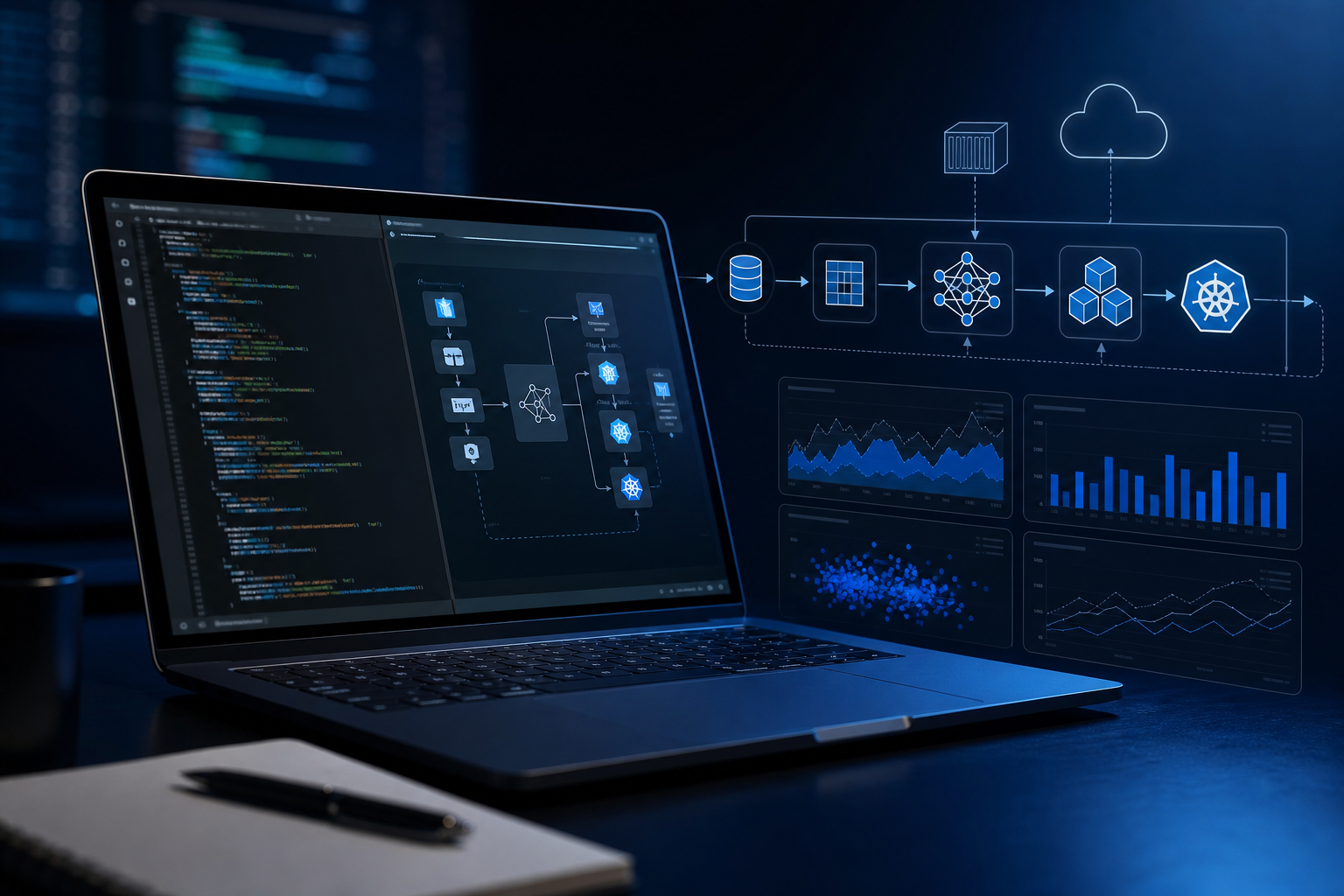
Most AI projects stall because production was planned too late. Gartner’s 2024 AI survey data consistently finds a gap between prototype success and operational deployment. The model looked fine in a notebook, then broke under real traffic, missing data, and unclear ownership. Python still leads ML work. With disciplined engineering, you can close the gap between experiment and deployment without waiting for a bespoke MLOps platform.
Winning teams treat ML as software engineering with uncertainty: versioned data, versioned models, and promotion gates that match what you use for payments or auth.
Key Takeaways
- Define the inference contract (schema, latency, failure modes) before tuning hyperparameters.
- Match serving pattern to SLA: batch, real-time API, or edge orchestration with GPU backend.
- Log prediction distributions, drift, and errors from day one; ML without telemetry is guesswork.
- Lock environments (uv, Poetry, Docker) so staging matches notebook assumptions.
- Automate promotion with eval harnesses and rollback, not manual “trust me” deploys.
Why do notebook prototypes fail in production?
Notebooks optimize for exploration: mutable state, implicit data paths, and cells run out of order. Production optimizes for repeatability, contracts, and operational ownership. The short answer: notebooks skip the interfaces other teams depend on (frontend, backend, data engineering, ops) until too late.
What breaks first under real traffic?
| Failure mode | Notebook assumption | Production reality |
|---|---|---|
| Schema drift | Clean CSV on disk | Nulls, new enum values, delayed features |
| Latency | Batch score overnight | User waits >2s and abandons |
| Scale | Single-machine fit | Concurrent requests exhaust GPU memory |
| Ownership | Data scientist deploys | On-call engineer has no runbook |
| Compliance | Ad-hoc exports | PII in logs, no audit trail |
According to Google’s Rules of ML engineering, teams should design production-ready pipelines early, even when the model is simple. A logistic regression with a clear API beats a deep network nobody can serve or monitor.
Citation capsule: Notebook prototypes fail when inference contracts, environment parity, and observability are deferred. Production ML requires the same interface discipline as payments APIs: explicit schemas, owned failure modes, and telemetry from the first deploy.
How do you define the inference contract first?
Before tuning hyperparameters, define the inference API: input schema, latency budget, output schema, and failure modes. FastAPI and Pydantic make this explicit in Python. When the contract is clear, frontend, backend, and data teams can work in parallel against OpenAPI docs and mocked responses.
Minimum contract fields
- Input schema with types, bounds, and required vs optional features.
- Output schema including confidence or uncertainty when decisions are automated.
- Latency SLO (p50 and p95) per environment.
- Error codes for validation failure, model unavailable, and upstream timeout.
- Idempotency rules for write-adjacent predictions (fraud flags, routing decisions).
Example failure mode matrix
| Condition | HTTP / event response | User-visible behavior |
|---|---|---|
| Invalid input | 422 with field errors | Form validation message |
| Model timeout | 503 with retry-after | Graceful fallback or queue |
| Low confidence | 200 with action: review | Route to human queue |
| Feature store miss | 503 or degraded mode | Document in runbook |
When the contract is published, QA writes contract tests before the model is final. Product defines what “low confidence” means for UX. Ops knows which alerts page them at 2 a.m.
[UNIQUE INSIGHT] Teams that stub the inference API with a constant or rules engine for two sprints often ship the product shell faster than teams waiting for model accuracy to plateau. Integration risk surfaces early; model swaps become a backend change, not a program reset.
Which model serving pattern fits your product?
For many products, a lightweight serving layer beats a heavyweight platform early on. Match pattern to SLA and cost, not to what worked in a Kaggle notebook.
Batch pipelines
Best for: nightly scoring, analytics, recommendation refresh, risk re-runs.
- Schedule with Airflow, Dagster, Prefect, or cron on container jobs.
- Write scores to warehouse or feature store with partition keys.
- Downstream apps read materialized results; no user-facing latency SLO on inference itself.
Batch is underrated for v1. If users do not need millisecond scores, batch saves GPU cost and simplifies rollback (re-run partition).
Real-time APIs
Best for: user-facing features with strict SLAs (search ranking, fraud check, support triage).
- FastAPI or gRPC service behind load balancer.
- Model loaded at startup or lazy-loaded with health checks.
- Horizontal scale on CPU services; GPU pools for heavy transformers with queue backpressure.
Set concurrency limits. A single GPU pod that accepts unbounded requests will OOM under spike traffic.
Edge or worker orchestration
Best for: lightweight routing, caching, auth, and small models; orchestration while heavy inference stays on GPU backends.
Cloudflare Workers and similar edge runtimes work well for request validation, feature assembly, and calling remote inference endpoints. Keep large PyTorch or Hugging Face models on dedicated inference nodes; do not pretend a 7B parameter model runs efficiently on every edge PoP.
| Pattern | Typical latency target | Ops complexity |
|---|---|---|
| Batch | Hours acceptable | Low to medium |
| Real-time API | <200ms p95 for simple models | Medium |
| GPU service + queue | Variable; async UX | Medium to high |
| Edge orchestration | <50ms for non-model work | Medium |
What belongs in your Python production stack?
Libraries like PyTorch, scikit-learn, and Hugging Face Transformers accelerate research. Production adds packaging, testing, and promotion discipline.
Environment reproducibility
- uv, Poetry, or locked Docker images with exact dependency hashes.
- Separate training and inference images when CUDA versions differ.
- Pin Python minor version across CI, staging, and production.
“Works on my machine” becomes “works in staging only” when feature code reads /Users/... paths or undeclared env vars.
Project layout that scales
ml/
  contracts/       # Pydantic schemas shared by train and serve
  training/        # notebooks exported to scripts, not notebooks in prod
  serving/         # FastAPI app, health checks
  eval/            # offline metrics, golden sets
  pipelines/       # batch jobs
tests/
  contract/
  integration/
Export notebook logic to tested modules. Keep notebooks for exploration; never mount Jupyter on production servers.
Testing pyramid for ML services
- Unit tests on feature transforms (including null and edge cases).
- Contract tests on API request/response against OpenAPI.
- Golden set evals comparing model output to approved baseline on fixed inputs.
- Load tests on inference path before marketing launches.
[PERSONAL EXPERIENCE] Teams we work with often catch 80% of production surprises in feature transform unit tests and contract tests, not in offline accuracy metrics alone.
Why is observability non-negotiable from day one?
Log prediction distributions, drift indicators, and error rates from day one. Without telemetry, you cannot tell whether a dip in engagement is a UX regression or model decay. Treat ML systems like any other critical service: dashboards, alerts, and runbooks.
What to log (without leaking PII)
| Signal | Purpose | Storage hint |
|---|---|---|
| Input feature summaries | Drift detection | Aggregated histograms, not raw rows |
| Prediction scores | Calibration monitoring | Time-series metrics |
| Latency p50/p95 | Capacity planning | APM |
| Error class counts | Alert routing | Logs + metrics |
| Model version ID | Rollback audits | Structured log field |
Define data retention with legal and security early. Model logs tempt teams to store full prompts or user rows; hash or truncate identifiers when possible.
Drift and decay workflows
- Weekly compare feature distributions to training baseline.
- Alert when error rate or low-confidence rate crosses threshold.
- Run offline eval on fresh labeled sample monthly.
- Document retrain trigger criteria (not “when someone notices”).
According to NIST AI Risk Management Framework guidance, monitoring and human oversight are core to trustworthy deployed AI. Observability is how engineering operationalizes that guidance without a separate governance slide deck.
Citation capsule: ML observability requires prediction distributions, latency, error classes, and model version tags from the first deploy. Without telemetry, product and ops cannot distinguish UX regressions from model decay or data drift.
How do you promote models from staging to production?
Automate promotion with the same rigor as application deploys. Manual SSH and ad-hoc pickle loads are where audits and incidents originate.
Promotion checklist
- Offline eval passes against golden set (metrics + thresholds documented).
- Shadow or canary traffic compared to incumbent model.
- Rollback artifact (previous model weights + config) one command away.
- Changelog entry with training data window and known limitations.
- On-call runbook updated with new version and alert thresholds.
Use object storage for artifacts (S3, GCS, R2) with immutable version IDs. Reference version in service config, not “latest” symlink in production.
Batch vs online promotion
Batch: promote new scorer; re-run partition; compare aggregate metrics before switching read pointer.
Online: canary 5% traffic; watch business KPIs and error budgets; expand or rollback via feature flag or router weight.
Never promote Friday afternoon without rollback drill. Model deploys fail in subtle ways (dtype mismatch, tokenizer version skew) that unit tests miss.
How do LLM features differ from classical ML in production?
LLM workloads add prompt versioning, token cost, latency variance, and safety filtering. The inference contract must include max tokens, timeout, and refusal behavior.
LLM-specific production concerns
| Concern | Mitigation |
|---|---|
| Prompt injection | Input sanitization, tool allowlists, output filtering |
| Cost spikes | Rate limits, caching for deterministic subtasks |
| Latency tails | Streaming UX, queue for async tasks |
| Nondeterminism | Temperature policy per use case; eval with fixed seeds offline |
| Vendor outage | Fallback model or degraded text path in runbook |
Pair RAG pipelines with eval harnesses before launch (see related patterns on internal knowledge governance). Retrieval quality dominates user trust more than model brand name.
For deeper POC-to-production LLM patterns, internal linking zones often point teams from notebook experiments to eval harnesses and governance docs before fine-tuning debates.
What roles and ownership prevent the handoff cliff?
Define owners before production traffic:
| Role | Owns |
|---|---|
| Product | UX for confidence, fallback copy, success metrics |
| Engineering | Serving, CI/CD, on-call runbooks |
| Data / ML | Training pipeline, eval thresholds, retrain triggers |
| Ops / SRE | Dashboards, alerts, capacity |
| Security / Legal | PII in logs, retention, model vendor contracts |
Without named owners, the notebook author becomes default on-call forever. That person leaves; the model stays dark.
How do you version data and features for reproducible training?
Model weights are useless without the data snapshot and feature code version that produced them. Store training dataset identifiers (hash, date range, query version) alongside artifact metadata. When regulators or customers ask “what data trained this?”, you need an answer in minutes, not a week of archaeology.
Feature pipeline practices
| Stage | Artifact to version | Why it matters |
|---|---|---|
| Raw ingest | Source batch ID | Replay and audit |
| Transform | Git SHA of feature code | Training-serving skew detection |
| Train split | Frozen partition file | Fair comparison across experiments |
| Eval set | Golden labels version | Promotion gate integrity |
Use pipeline tools (Dagster assets, Airflow datasets) or disciplined scripts; the tool matters less than immutability. Never overwrite production feature tables in place; append partitions and swap pointers.
Training-serving skew is the silent killer: notebook used pandas one-liner; production service applies slightly different null handling. Contract tests on feature outputs between batch and online paths catch this before users do.
What security and compliance checks apply before launch?
ML services process sensitive inputs by default (support tickets, documents, user behavior). Security review should cover:
- Input validation and size limits (DoS via huge payloads).
- Output filtering for PII leakage in LLM responses.
- Access control on inference endpoints (not public S3 URLs for models).
- Vendor DPAs when using hosted inference APIs.
- Retention policy for logs and human review queues.
Run threat modeling on the inference path: who can call the API, what happens on prompt injection, can an attacker exfiltrate training data via embeddings? Document residual risk like any other production service.
For regulated industries, map model decisions to human override paths where automated denial affects rights (credit, hiring, healthcare triage). The contract’s low-confidence branch is often a compliance requirement, not a nice UX extra.
Worked example: document triage API in eight weeks
A practical slice many ops teams need: classify inbound PDFs or emails into queues (billing, technical, legal).
Week 1–2: Publish FastAPI stub returning rule-based labels; frontend integrates upload and queue display.
Week 3–4: Export sklearn or small transformer classifier; golden set of 200 labeled docs; offline F1 threshold documented.
Week 5: Add logging (label distribution, latency); deploy to staging with shadow mode comparing model vs rules.
Week 6: Canary 10% traffic; ops reviews misroutes in exception UI.
Week 7–8: Promote to 100% or rollback; runbook and on-call rotation assigned to platform team, not notebook author.
This slice delivers user value before GPU clusters or MLOps platforms. Heavier models slot behind the same contract later.
[PERSONAL EXPERIENCE] Document triage and similar routing models are often the best first production ML slice because wrong answers are visible in a queue ops already monitors, not buried in silent ranking drift.
FAQ
Do we need Kubernetes for ML serving?
Not on day one. A container on managed compute (ECS, Cloud Run, Modal) with health checks often suffices until you need multi-GPU scheduling or complex autoscaling.
Is MLflow or Weights & Biases required?
Helpful for experiment tracking, not mandatory. Minimum bar is versioned artifacts, reproducible env, and eval metrics stored where promotion gates can read them.
Can we serve scikit-learn and PyTorch in one API?
Yes, with separate routes or model routers. Keep dependency isolation in mind; heavy torch imports slow cold start for tiny sklearn models unless split services.
How do we handle GPU cost?
Autoscale down off-peak, batch when possible, quantize or distill when accuracy tradeoff is acceptable, and cache deterministic LLM subtasks. Review idle GPU spend weekly.
What about feature stores?
Add when multiple models consume the same features or training-serving skew appears. Early products can read from warehouse tables with clear freshness SLAs.
Should data scientists own production?
They should own model quality and eval thresholds. Platform or backend engineering should own serving uptime, consistent with DORA ownership patterns for reliable services.
How do we test notebooks before export?
Run exported modules in CI with pytest. Ban production deploy from .ipynb directly. Parameterize data paths via env vars.
When is fine-tuning worth it?
When eval proves base model fails on domain-specific tasks and RAG plus prompting cannot meet thresholds. Fine-tuning without eval harness wastes GPU and creates rollback risk.
How do we coordinate with frontend on latency budgets?
Share p95 inference latency in the API contract doc and alert when regression exceeds agreed threshold. Product should define loading and fallback UX before model accuracy debates finish.
Closing thought
Python remains the default language for ML because the ecosystem moves fast and hiring is deep. Speed without engineering discipline produces demos that ops teams refuse to run.
Define the inference contract first, pick serving patterns that match real SLAs, lock environments, and instrument from day one. Version data and models, automate promotion, and name owners before traffic arrives. That is how notebook experiments become software your organization can ship and sleep through.
For teams moving from LLM proof-of-concept to governed production, pair this serving foundation with eval harnesses and retrieval governance before debating fine-tuning spend.
How do you run ML services on-call without burning out data scientists?
On-call rotation for inference APIs should sit with platform or backend engineers who already run services, supported by ML owners who define eval thresholds and retrain playbooks. Data scientists join escalations for model quality incidents, not for every 503 caused by a bad deploy config.
Runbooks should cover: scale-up steps, rollback to previous artifact, switch to rules-only fallback, and communication template for product when degraded mode is active. Game-day exercises quarterly: inject latency, kill GPU pod, verify alerts fire and rollback completes within SLO.
Capacity planning review monthly: request growth vs p95 latency vs GPU utilization. ML traffic spikes during product launches; autoscaling policies need max limits finance approved in advance.
Citation capsule: Sustainable ML operations assign service uptime to engineering on-call, model quality thresholds to ML owners, and document rollback plus degraded-mode paths before production traffic. Without that split, data scientists become permanent pager duty and leave.
Building something similar?
Tell us about your stack, timeline, and goals. We reply within one business day.
Let's Discuss Your Vision