Applied AI: From LLM Proof of Concept to Production
Gartner reports most GenAI pilots stall before production. Scope LLM PoCs with evals, add RAG where retrieval is measured, and ship ML like any critical service.
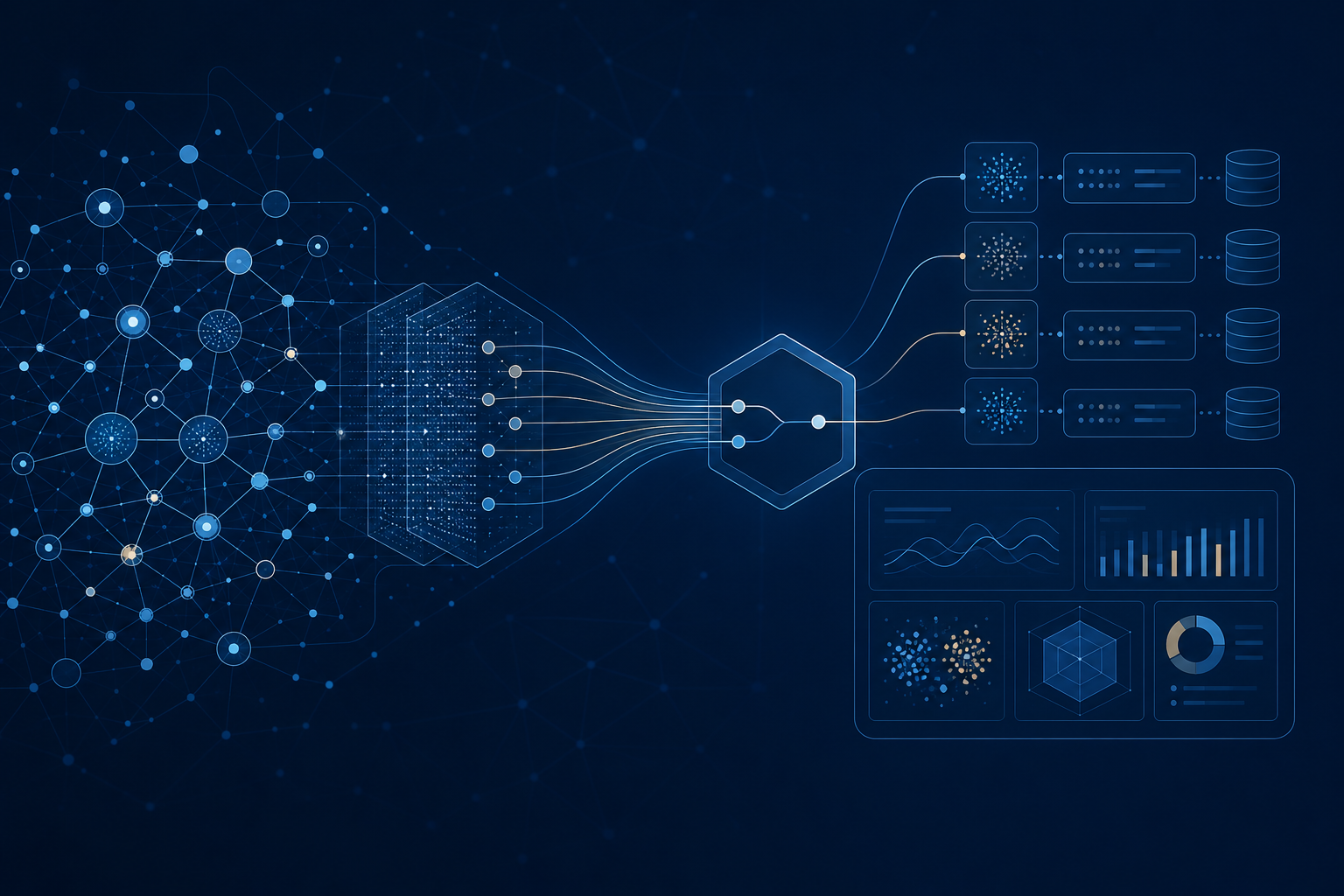
Gartner predicts that roughly 30% of generative AI projects will be abandoned after proof of concept by the end of 2025. The failure mode is rarely the model itself. Teams skip evaluation datasets, treat security review as a post-demo surprise, and discover that a flashy Streamlit prototype cannot survive real traffic or messy source data.
Applied AI should shorten feedback loops, not add a science project that only researchers understand. This article covers when an LLM PoC is worth building, how RAG fits operations and product, what traditional ML still requires, and why data quality automation often delivers the highest ROI before you fine-tune anything.
Key Takeaways
- PoCs need eval datasets, cost ceilings, and failure UX on day one, not after the demo.
- RAG improves internal search when chunking and retrieval quality are measured, not guessed.
- Production ML needs inference contracts, drift monitoring, and rollback like payments code.
- Data cleanup pipelines reduce hallucinated numbers and broken dashboards downstream.
- Gartner expects many GenAI pilots to stall: plan production ownership before the first API call.
When is an LLM PoC worth building?
Build a two- to four-week LLM proof of concept when a specific user task has measurable time savings and you can define success before writing prompts. McKinsey’s 2024 state of AI survey found that organizations seeing the most value from AI tie use cases to business KPIs, not novelty. If you cannot name the metric, defer the PoC.
What signals make a PoC a good bet?
Strong PoC candidates share four traits:
- Task clarity: Draft, classify, extract, or summarize a bounded workflow (support reply, invoice field, policy clause).
- Measurable outcomes: Accuracy on a labeled set, latency under a budget, or cost per successful completion.
- Known data boundary: Legal and security reviewers understand what text, PII, or files leave your environment.
- Human fallback: Operators can override or reject model output without filing a ticket.
Weak candidates include “add ChatGPT to the product” without a workflow, or demos that require perfect documents your operations team has never cleaned.
What tools belong in a PoC, not in production?
Use OpenAI or Anthropic APIs, LangChain or LlamaIndex for orchestration, and Streamlit or a thin internal React shell for demos. These are learning surfaces. They help you test retrieval strategies, prompt shapes, and failure copy before you commit to a serving stack.
[PERSONAL EXPERIENCE] Teams we work with often treat the PoC stack as disposable on purpose. The artifact that survives is the eval set, the inference contract sketch, and the list of data sources that must be fixed before any customer sees output.
Citation capsule: McKinsey’s 2024 AI research links measurable KPIs to higher reported value from AI deployments. LLM PoCs that start with a labeled eval set and a cost ceiling are more likely to earn a production budget than open-ended chat experiments (The state of AI, McKinsey, 2024).
[IMAGE: Engineer reviewing labeled eval spreadsheet beside LLM chat demo on laptop - search terms: machine learning evaluation dashboard office]
How do you scope a two- to four-week LLM PoC?
Scope a PoC by fixing the user story, the eval dataset, and the kill criteria in week one. Stanford HAI’s 2025 AI Index notes rising corporate AI investment alongside persistent gaps in responsible deployment practices. A tight scope prevents the PoC from becoming an unpaid research program.
What deliverables should week one produce?
By the end of week one, you should have:
- A one-page problem statement with the user, trigger, and success metric.
- 50 to 200 labeled examples (even rough labels beat zero).
- A cost model (tokens per task, expected daily volume, monthly ceiling).
- A security memo listing data classes, retention, and vendor subprocessors.
- Failure UX notes (empty state, low-confidence warning, escalation path).
Weeks two through four iterate on prompts, retrieval, and tool use against that eval set. The demo is the last step, not the first.
How do eval datasets change the conversation?
Eval datasets turn subjective “it feels smarter” debates into pass or fail gates. Track precision on extraction tasks, win rate on side-by-side draft quality, or human approval rate on suggested replies. When leadership asks for production funding, you show curves, not screenshots.
[UNIQUE INSIGHT] The cheapest PoC upgrade is often negative examples: cases where the model must refuse, escalate, or say “I don’t know.” Teams that only eval happy paths ship assistants that confabulate under edge-case documents.
| PoC artifact | Purpose | Production carryover |
|---|---|---|
| Labeled eval set | Objective go or no-go | Regression suite for releases |
| Cost model | Budget approval | Rate limits and caching strategy |
| Security memo | Legal sign-off | Data handling runbook |
| Failure UX copy | Trust in demos | Live product error states |
| Inference contract sketch | API alignment | FastAPI + Pydantic schema |
[CHART: Horizontal bar - PoC success factors ranked by delivery teams (eval dataset, ownership, data quality, prompt polish, model choice) - source: practitioner synthesis from McKinsey and Gartner adoption reports]
What makes LLM PoCs fail before production?
LLM PoCs fail when ownership, evaluation, and operations are planned after the demo wins applause. Gartner expects a large share of generative AI projects to stall post-PoC because teams underestimate data preparation and overestimate prompt magic.
Which mistakes show up most often?
The recurring failure patterns are predictable:
- No production owner: The PoC author returns to product work; nobody maintains prompts or evals.
- Demo data ≠ live data: PDFs are clean in the lab; production uploads are scans, tables, and redacted clauses.
- Latency and cost surprises: A chain of six LLM calls works in Streamlit; it breaks the SLA at 10,000 daily users.
- Missing observability: Nobody logs prompts, retrieval hits, token usage, or user overrides.
- Compliance afterthought: PII, retention, and regional residency get reviewed weeks before launch.
How do you design a fast, honest no?
A fast no saves quarters. Kill the PoC when, after two iteration cycles, eval scores stay flat, human reviewers reject most outputs, or data cleanup estimates exceed the business value of automation. Document the no with metrics so the organization does not retry the same dead end six months later.
Citation capsule: Gartner forecasts that many generative AI projects will be abandoned after proof of concept when teams lack clear outcomes and operational plans. Treating kill criteria as a first-class deliverable reduces sunk-cost demos that never reach a runbook (Generative AI projects abandoned after PoC, Gartner, 2024).
How does RAG fit operations and product?
Retrieval-Augmented Generation (RAG) fits when answers must cite your documents: HR policies, engineering specs, support macros, contract playbooks, or field service history. Deloitte’s 2024 enterprise AI report found that knowledge management and customer support are among the most common GenAI use cases in large organizations. RAG is the bridge between static knowledge bases and conversational interfaces.
When should you choose RAG over fine-tuning?
Choose RAG when:
- Source material changes frequently (policies, pricing, product docs).
- Citations and audit trails matter for compliance or operator trust.
- You need to swap models without retraining on proprietary text.
Fine-tuning can wait until retrieval, prompts, and evals plateau. Most teams overestimate how much custom weights help before they fix chunking and metadata.
What does a minimal RAG architecture look like?
A production-grade minimal stack includes:
- Ingestion pipeline: Parse PDFs, HTML, tickets; normalize encoding; strip boilerplate.
- Chunking strategy: Section-aware splits with overlap; table and list handling explicit.
- Embeddings + index: Managed vector store or database with pgvector when volume is modest.
- Retrieval evals: Recall@k on a question set with known gold documents.
- Generation layer: Prompt with citations; refuse when retrieval confidence is low.
- Feedback loop: Thumbs down, missing doc reports, and periodic re-index jobs.
Bad retrieval cannot be fixed with a better prompt. If the right paragraph never enters context, the model will invent plausible policy language.
Applied AI & machine learning engagements often pair RAG with data cleanup pipelines so the model stops inventing numbers your spreadsheets already have wrong.
Citation capsule: Deloitte’s 2024 research places knowledge management and customer support among top enterprise GenAI use cases. RAG succeeds when ingestion, chunking, and retrieval metrics are tested before chat UI polish (State of Generative AI in the Enterprise, Deloitte, 2024).
[IMAGE: Diagram-style illustration of documents flowing through chunking embedding retrieval to LLM answer with citations - search terms: RAG retrieval augmented generation architecture]
How do you evaluate retrieval quality before shipping RAG?
Evaluate retrieval with labeled question-document pairs and track recall before you A/B test button colors. Pinecone’s RAG evaluation guide and academic benchmarks emphasize that retrieval errors dominate end-user perceived quality in document QA systems.
Which metrics matter at PoC and at scale?
Start with:
- Recall@k: Does the gold chunk appear in the top k retrieved segments?
- MRR (mean reciprocal rank): How high does the first relevant chunk rank?
- Citation accuracy: Does the generated answer only cite retrieved text?
- Abstention rate: How often does the system refuse when retrieval is weak?
Add human review on a weekly sample once you are in staging. Automate regression runs on every ingestion or embedding model change.
How do chunking and metadata affect results?
Chunking is not a hyperparameter trivia exercise. Headers, page numbers, product SKUs, and effective dates belong in metadata filters. Support tickets need thread boundaries; legal docs need clause boundaries. [PERSONAL EXPERIENCE] We have seen recall jump more from fixing PDF table extraction than from switching embedding models.
| Retrieval issue | Symptom | Fix |
|---|---|---|
| Chunks too large | Right doc, wrong detail | Smaller splits with overlap |
| Chunks too small | Lost context | Merge by section heading |
| Stale index | Outdated answers | Scheduled re-ingestion |
| Missing metadata | Cross-product bleed | Filter by product, region, date |
| Scanned PDFs | Garbage embeddings | OCR + layout-aware parsing |
[CHART: Line chart - Recall@5 improving over three iteration cycles (baseline chunking, metadata filters, OCR fix) - source: illustrative PoC progression pattern]
What about traditional ML and NLP in 2026?
Traditional ML and NLP still matter when APIs are not enough: demand forecasting, fraud scoring, custom classifiers on proprietary features, or computer vision on edge hardware. Stanford HAI’s 2025 AI Index documents continued growth in AI publications and industrial deployment across domains beyond text generation. LLM hype does not replace gradient-based models where latency, cost, or interpretability favor smaller specialized weights.
When do custom models beat general LLMs?
Prefer TensorFlow, PyTorch, or scikit-learn pipelines when:
- Inputs are structured (time series, tabular, sensor logs).
- Inference must run offline or on-device with tight millisecond budgets.
- Explainability requirements favor feature importance over prose rationale.
- Training data is abundant and labels are stable.
Use LLMs for language-heavy tasks; use classical ML for numeric pattern recognition. Hybrid systems are normal: an LLM drafts text; a classifier routes tickets; a forecaster drives inventory.
How does the PoC-to-production handoff differ?
The handoff matches LLM work with one extra emphasis: dataset versioning. Lock training snapshots, document label definitions, and store evaluation reports beside model artifacts. Promotion gates should include offline metrics, shadow mode or canary traffic, and rollback within minutes.
Citation capsule: Stanford HAI’s AI Index tracks broad industrial AI adoption beyond generative text, including vision, robotics, and structured prediction. Teams that maintain dataset versioning and inference contracts for classical ML avoid the same production cliffs as LLM pilots (AI Index Report 2025, Stanford HAI, 2025).
How do you ship ML inference like production software?
Ship ML inference with the same rigor as payments or auth: explicit contracts, automated tests, observability, and rollback. Google’s DORA research links smaller batch sizes, frequent deployment, and stable on-call practices to higher software delivery performance. ML services fail when treated as research notebooks with a load balancer attached.
What belongs in the inference contract?
Define the contract before optimizing the model:
- Input schema: Types, bounds, nullable fields (Pydantic models in FastAPI work well).
- Output schema: Scores, labels, confidence, optional explanation payloads.
- SLA: p95 latency, max payload size, rate limits.
- Failure modes: Timeouts, default actions, circuit breaker behavior.
- Versioning: Model ID and schema version in every response header or body.
Frontend, backend, and data teams can integrate in parallel once the contract is stable, even if weights are still changing behind the same endpoint.
Which serving patterns fit early production?
Common patterns:
- Batch pipelines for nightly scoring, analytics, and retraining triggers (Airflow, Dagster, Step Functions).
- Real-time APIs for user-facing features with autoscaling containers or serverless wrappers.
- Async workers for long documents or multi-step chains that should not block HTTP threads.
- Edge orchestration for routing and caching while heavy inference stays on GPU backends.
Cloudflare Workers and similar edge runtimes help with auth, rate limiting, and request shaping. They are not a substitute for GPU inference when models are large.
What should you monitor from day one?
Log prediction distributions, error rates, data drift indicators, and business outcomes tied to model decisions. Alert on:
- Sudden shifts in input feature distributions or embedding norms.
- Spike in abstentions, timeouts, or human overrides.
- Cost per successful task (tokens, GPU seconds).
- Regression failures on the eval suite after each deploy.
Without telemetry, you cannot tell whether a dip in engagement is a UX regression or model decay.
[INTERNAL-LINK: From Notebook to Production Python AI/ML → deeper serving and observability patterns for Python teams]
Citation capsule: DORA research associates frequent, small deployments with better stability and recovery times. ML systems that use the same CI/CD, feature flags, and rollback levers as core product services reduce the “works in notebook” cliff (DORA Research, Google, ongoing).
[IMAGE: Observability dashboard showing model latency drift and error rate widgets - search terms: machine learning monitoring production dashboard]
How do you automate data quality with AI?
Automate data quality when bad inputs cause bad model outputs and broken operator dashboards. IBM’s 2024 Cost of a Data Breach report highlights that data quality and governance failures compound downstream risk; for applied AI, the immediate pain is often wrong KPIs and confident hallucinations built on dirty spreadsheets.
Which cleanup jobs deliver fast ROI?
High-ROI pipelines include:
- Duplicate detection across CRM, ERP, and support exports.
- Format normalization (dates, currencies, phone numbers, SKUs).
- Entity resolution (same customer, three spellings).
- Anomaly flagging on fields that should never be null or negative.
- Document classification routing files to the right ingestion path.
These wins are unglamorous. They reduce trust issues in downstream dashboards and make RAG retrieval trustworthy.
How do LLMs help without owning the golden record?
Use LLMs as assistants, not authorities:
- Propose standardizations for human approval.
- Extract structured fields from unstructured tickets for validation queues.
- Summarize diffs when two systems disagree on a record.
The golden record still lives in governed tables with audit logs. Models suggest; workflows approve.
operations teams feel the impact first when field data stops getting re-keyed three times and support search returns the same policy version everyone else sees.
Citation capsule: IBM’s 2024 breach research underscores how weak data handling increases organizational risk exposure. For applied AI, uncorrected source data produces confident wrong answers; cleanup pipelines often outperform larger models on operational trust (Cost of a Data Breach Report 2024, IBM, 2024).
[CHART: Donut chart - Share of applied AI effort by phase (data cleanup, retrieval evals, serving, prompt tuning) for successful internal deployments - source: practitioner estimate aligned with Gartner and Deloitte adoption patterns]
What governance do applied AI systems need before launch?
Governance means clear ownership, access controls, and incident response before users depend on outputs. NIST’s AI Risk Management Framework provides a practical structure: map context, measure risks, manage controls, and govern continuously. You do not need a 200-page policy to start; you need named owners and tested runbooks.
Who owns the model in production?
Your engineering or data team owns production behavior, with runbooks, not the vendor who built the demo. Ownership includes:
- Prompt and retrieval configuration changes.
- Eval regression gates in CI.
- Vendor API key rotation and cost alerts.
- User override analytics and periodic bias or safety reviews.
What belongs in a minimal AI runbook?
At minimum, document:
- Escalation path when the model produces harmful or non-compliant output.
- Rollback steps (feature flag, pinned model version, cached responses).
- Data retention and deletion procedures for prompts and logs.
- Access matrix for who can change production prompts or indexes.
- Incident severity definitions (wrong draft vs. leaked PII).
Security reviewers say yes faster when evidence accumulates release by release, similar to incremental platform modernization.
[UNIQUE INSIGHT] Teams that reuse their existing software on-call rotation for ML incidents integrate AI into operations culture. Separate “AI war rooms” often lose executive attention after the first quarter.
FAQ
Do we need a vector database on day one?
Not always. Start with managed retrieval or pgvector at modest volume. Scale dedicated vector infrastructure when evals prove recall requirements and query load outgrow simpler stores. Many PoCs fail before storage limits, not because of them.
Who owns the model in production?
Your engineering or data team, with explicit runbooks and eval gates. Vendors and consultants can bootstrap PoCs, but internal owners must maintain prompts, indexes, and incident response after launch.
Is fine-tuning required?
Usually later, if ever. Prompting, retrieval, tool use, and eval discipline beat premature fine-tuning for most document and workflow tasks. Fine-tune when you have stable labels, clear ROI, and proof that base models cannot reach your metric target.
How much should we budget for LLM API costs in PoC?
Model a per-task token estimate times daily volume with a 30 to 50% buffer for iteration. OpenAI’s pricing pages change; your PoC cost sheet should include rate limits and caching assumptions so finance sees a ceiling, not an open tab.
Can we skip data cleanup if we use RAG?
No. RAG retrieves what you indexed. Garbage in the index produces confident wrong citations. Cleanup and ingestion quality determine RAG ceiling more often than embedding model choice.
Closing thought
Applied AI is applied engineering: hypotheses, metrics, and a path to production, or a fast no before you confuse customers and operators. PoCs earn their keep when they produce eval sets, contracts, and kill criteria. RAG earns its keep when retrieval is measured. ML earns its keep when inference behaves like any other service your on-call team can roll back at 2 a.m.
If you are scoping LLM pilots, internal search, or ML features that must survive audit and traffic, see Applied AI & machine learning for how teams graduate experiments into owned production systems without demo-driven debt.
Building something similar?
Tell us about your stack, timeline, and goals. We reply within one business day.
Let's Discuss Your Vision